

Framework
What Makes a Video "Clippable"? A Framework for Knowledge Workers
A two-hour documentary has maybe eight minutes of insight you'll ever use again. A 40-minute tutorial, maybe two. The skill worth building isn't watching more video — it's knowing which eight minutes to keep. That skill is the front door to video knowledge management: the practice of turning hours of watching into something you can actually find later.
Most people never build it. They watch the whole thing, feel productive, and remember almost none of it. So before the tools, the habits, or the tags, there's one question: what actually makes a moment worth saving?
Saving everything is the same as saving nothing
Start with what the research says about marking things down, because it's blunt.
In the largest review of study techniques — Dunlosky and colleagues, 2013 — highlighting and rereading came out near the bottom. Low utility. The two techniques that actually worked were practice testing and spacing your review out over time. Marking a passage, on its own, does close to nothing for memory.
But there's a twist, and it's the whole point of this article. Earlier work by Fowler and Barker found highlighting did help — but only when students were limited in how much they were allowed to mark. Give someone an unlimited highlighter and they paint the page yellow. Cap them at one sentence a paragraph and something changes: they have to decide. The constraint forces the judgement, and the judgement is where the learning happens.
Clipping video is the same, with a bigger yellow highlighter. If you clip everything that seems mildly interesting, you've built a second YouTube — just as unsearchable, twice as guilt-inducing. The value isn't in the clip. It's in the choice of what not to clip.
The numbers back the instinct that most of a video is skippable. In one study of online lectures, the average viewer watched under 60% of the video, only about a third finished, and past a point more watching predicted worse results (Harrison, 2020). The good stuff is concentrated. Your job is to find it.
Four kinds of clippable moment
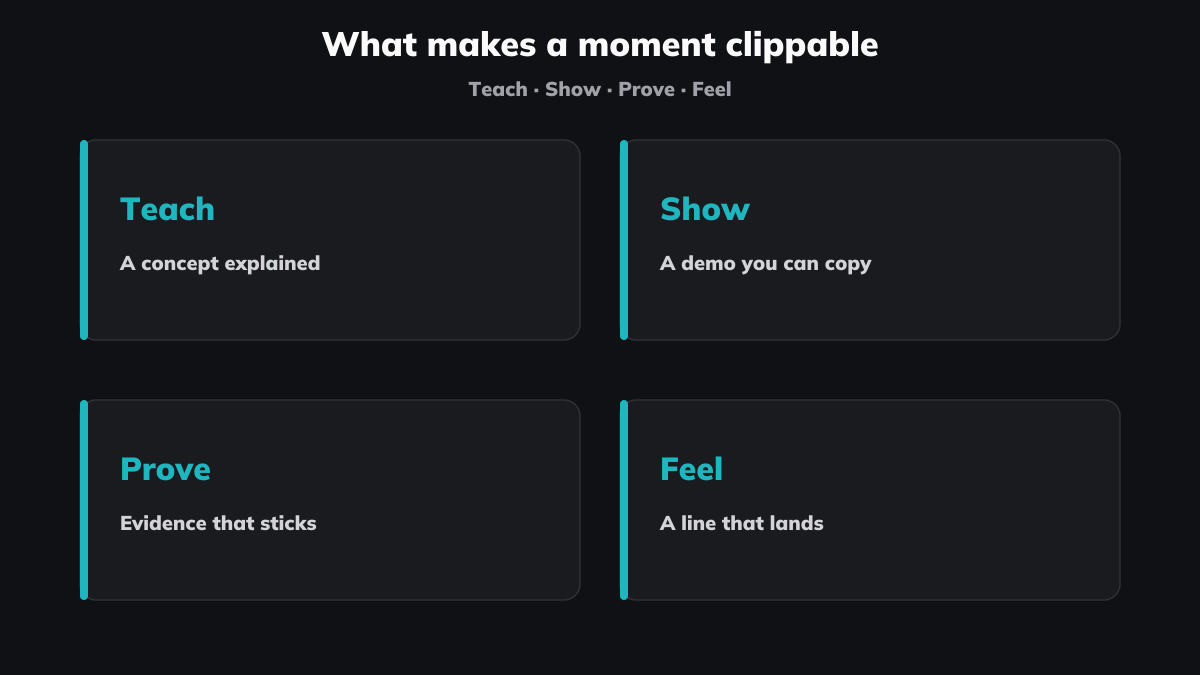
Here's the framework. Four types. When a moment fits one of them, clip it. When it doesn't, let it play.
Teach. An explanation that made something click. The 90 seconds where a fuzzy concept turned sharp. A 3Blue1Brown segment where the visual finally makes the maths obvious, or the one paragraph of a Huberman episode that explains why the protocol works, not just what it is. If you'd struggle to re-explain it from memory, and you'll want it again, it's a Teach moment.
Show. A demonstration — someone doing the thing, not describing it. The exact hand position in a guitar lesson. The precise sequence of steps in a recipe. On-screen code being written in real time. The tactical run-through in match footage. Show moments are the ones a written note can't hold, because the value is in watching it done.
Prove. Evidence. A number, a chart, a result, a source you'll want to cite. The study a talk references at 12:04. The before-and-after. The one slide with the data that changes your mind. Prove moments are what you reach for when you need to back up a claim later — the raw material of a video knowledge base.
Feel. The rarer one, and the reason not everything reduces to a transcript. A moment that shifts how you think or gives you the push to start. The close of a commencement speech. The thirty seconds of a founder's story that reframes your own week. You won't clip many of these. The ones you do, you'll return to more than any Teach clip.
Most genres lean toward one type. Tutorials are full of Show and Teach. Talks and documentaries carry Prove and Feel. Lectures are Teach with the occasional Prove. Knowing the type you're hunting for makes it easier to spot the moment as it goes past.
The clip test
When you're unsure, one question settles it.
Would you search for this six months from now?
Not "is this interesting." Almost everything is interesting in the moment — that's why it got made. The real test is whether future you, with a specific need, would go looking for this exact moment. If yes, clip it and tag it with the word you'd search. If you can't imagine the search, let it go.
This is the constraint from the highlighting research, made practical. It turns a vague "seems useful" into a concrete decision, and it keeps your library made of things you'll actually retrieve.
Clip while you watch, not after
The habit only works in real time.
Promise yourself you'll "go back and clip the good parts later" and you won't — the video's finished, the momentum's gone, and re-scrubbing a 40-minute talk to find the two moments is exactly the tedium you're trying to escape. Clip as you watch. See a moment pass the test, mark it, keep watching. It costs about twenty seconds and it's the difference between a habit that survives and a chore that doesn't.
There's a bonus the learning science predicts: the small act of deciding this one matters is itself a form of active engagement. You're not passively absorbing anymore. You're making judgements as you go — which, unlike watching, is something your memory actually holds onto.
From clips to a video knowledge base
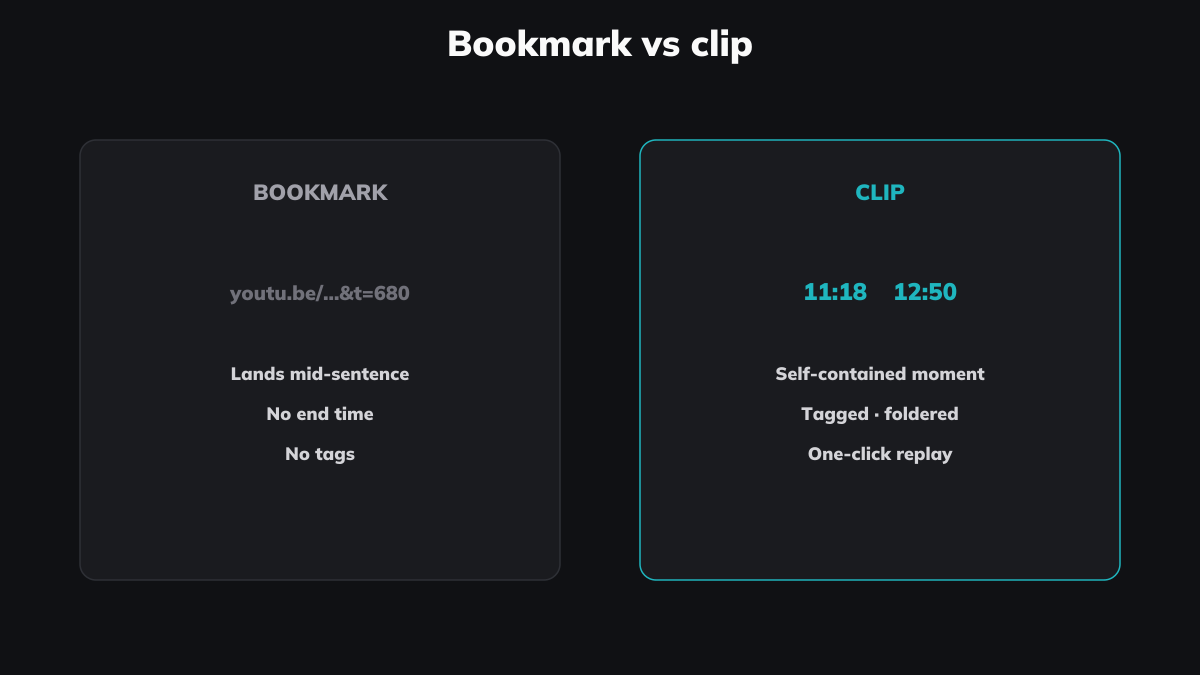
One clip is trivia. A hundred well-chosen clips, tagged and searchable, is something else — a personal video knowledge base you built one deliberate moment at a time.
This is what "video knowledge management" means for an individual, as opposed to the corporate training-library sense the term usually carries. Not a folder of downloads. A living collection where you search spaced repetition and get four explanations from four people, or search pull-back and watch every example you've ever saved, back to back. The clips compound. The library starts answering questions you didn't know to ask when you saved them.
Text tools reach for this and don't quite hold it — Notion, Obsidian, and Anki all treat video as a second-class citizen. The moment, not the note, has to be the atomic unit.
Where the framework stops being useful
Two honest limits, because a framework that claims everything is lying.
Some video resists clipping. A documentary's argument builds over ninety minutes; the value is the arc, and no eight-minute cut carries it. A narrative talk lands because of the setup you'd lose. When the whole is the point, watch the whole — don't force it through the framework.
And a warning the other direction. There's real evidence that chopping everything into fragments can hurt you: a 2026 study in Communications Psychology found people remembered less from short, rapidly-switching video than from longer video. Clipping done wrong — collecting decontextualised bits you never revisit — is just doom-scrolling with extra steps. What separates a knowledge base from a fragment pile is intent: you clip to return, and then you return. A hundred clips you never reopen isn't a library. It's a graveyard with good tags.
So the framework is a filter, not a rule. Teach, Show, Prove, Feel — and the six-month test. Get those right and the watching finally starts to add up.
Start recognising clippable moments — free, no account required.