

Story
Sports Coaching Video Analysis Without a Hudl Budget

You have twenty hours of game footage. Your pre-game meeting is in two hours. What do you actually show the team?
Every coach who's filmed a season knows this squeeze. The footage exists — phone on a tripod, a club Veo, a parent with a decent camera. Capturing the games was never the hard part. Finding the four clips that teach this week's lesson, before the meeting starts, is.
So most coaches do one of two things. They show a full half and hope the players spot the pattern (they don't). Or they spend their Sunday night scrubbing a timeline, drag past the throw-in three times, give up, and walk into the meeting with a vague "we switched off in transition." The footage was full of proof. None of it was reachable in time.
This is a retrieval problem dressed up as a time problem. And it's worth solving, because video review genuinely works.
Why review works — when you can get to the right moment
This isn't a hunch. A 2021 systematic review of video-based feedback in physical education found that visual feedback reliably improves skill acquisition and motor learning across sports (Spittle et al., German Journal of Exercise and Sport Research). Seeing yourself do the thing beats being told about it.
But there's a condition buried in the research. Anders Ericsson's work on deliberate practice — the foundation of the whole expertise field — found that improvement comes from immediate, specific feedback on particular attempts, not from volume (Ericsson et al., 2007). A full-game rewatch isn't specific feedback. "Watch these six times you stepped up too early, one after another" — that is.
So the value of your footage is real. It's just locked behind the eight minutes that matter inside twenty hours that don't.
Where the big platforms fit — and where they don't
If you coach at a club with a budget, you might already have Hudl or Veo. Worth being straight about them: they're excellent at what they do. Hudl pairs analysis software with Focus hardware cameras; Veo sells an AI camera that records the whole pitch and follows play on its own (Hudl, Veo, 2025). For a club that can fund the hardware and the subscription and wants whole-game capture plus stats, they're the right call.
Most coaches aren't that club.
You're a volunteer U14 manager with games on your phone. A junior tennis coach with serve clips and a few YouTube breakdowns you keep meaning to show. A club runner self-coaching off a parkrun video and a form analysis you found online. You don't need a capture system — you've got more footage than you can use. You need a light way to clip, tag, and find moments across all of it. That category — call it a personal sports video analysis tool rather than a club platform — is barely served.
And there's a quieter reason not to pour a season into a heavyweight tool: the tool can leave. TechSmith retired Coach's Eye in 2021 and pulled it from the app stores the year after; Hudl Technique got folded into OnForm. Coaches who'd tagged years of footage inside them had to migrate or lose the lot. One coach put it plainly when the shutdown email landed — the app "allowed you to record on any device, analyze the video in slow motion... I'll be sad to see it go" (Jason Gaylord, 2021). Where your library lives matters as much as what it does.
The clipping workflow
Here's the change in habit. Watch the game once, with a clipping mindset, and mark the moments as they happen.
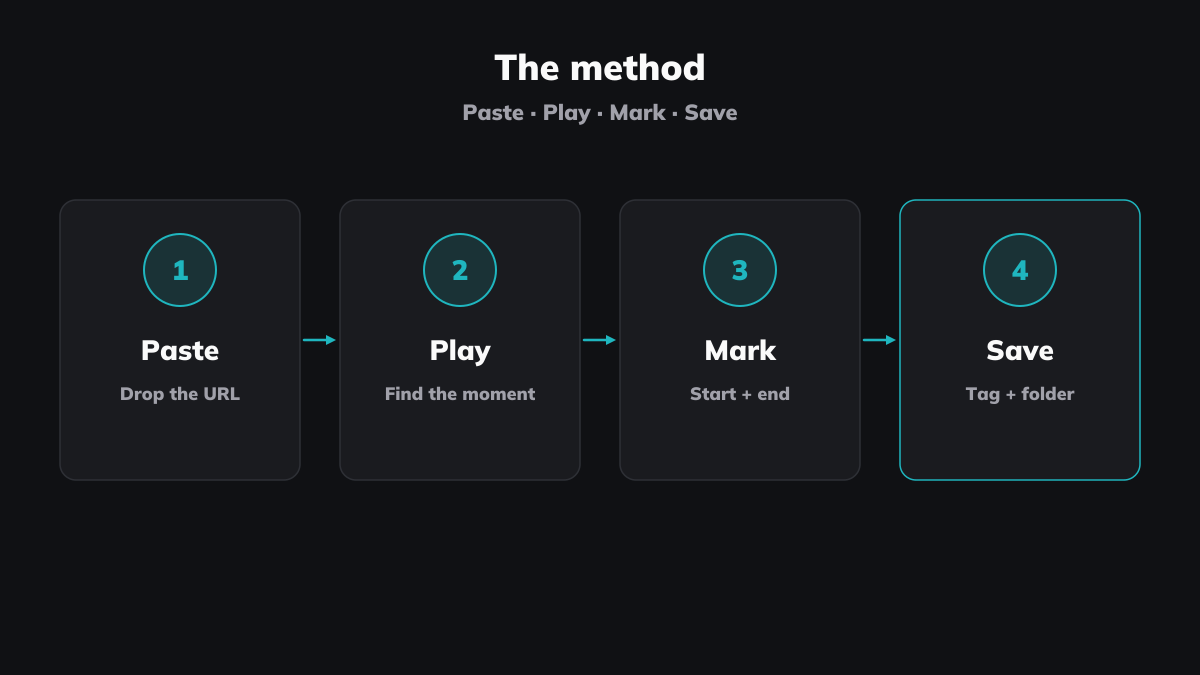
A clip is just a start and end on the timeline — the fifteen seconds around a goal conceded, the ten seconds of a perfect press trigger, the serve where the toss drifted. You watch the match through at speed, and every time something teachable shows up, you mark it. Good or bad. Yours or the opposition's.
A 90-minute game has maybe a dozen genuinely teachable moments. Clipping them takes twenty minutes the morning after, while you still remember what you were looking at. At the end you don't have a 90-minute file you'll never reopen. You've got twelve labelled moments, each two seconds away.
Do that across a season and the raw match files can go quiet. The clips are your analysis now.
Building a coaching library
A folder of clips beats a folder of full games. A tagged library is where coaching gets sharp.
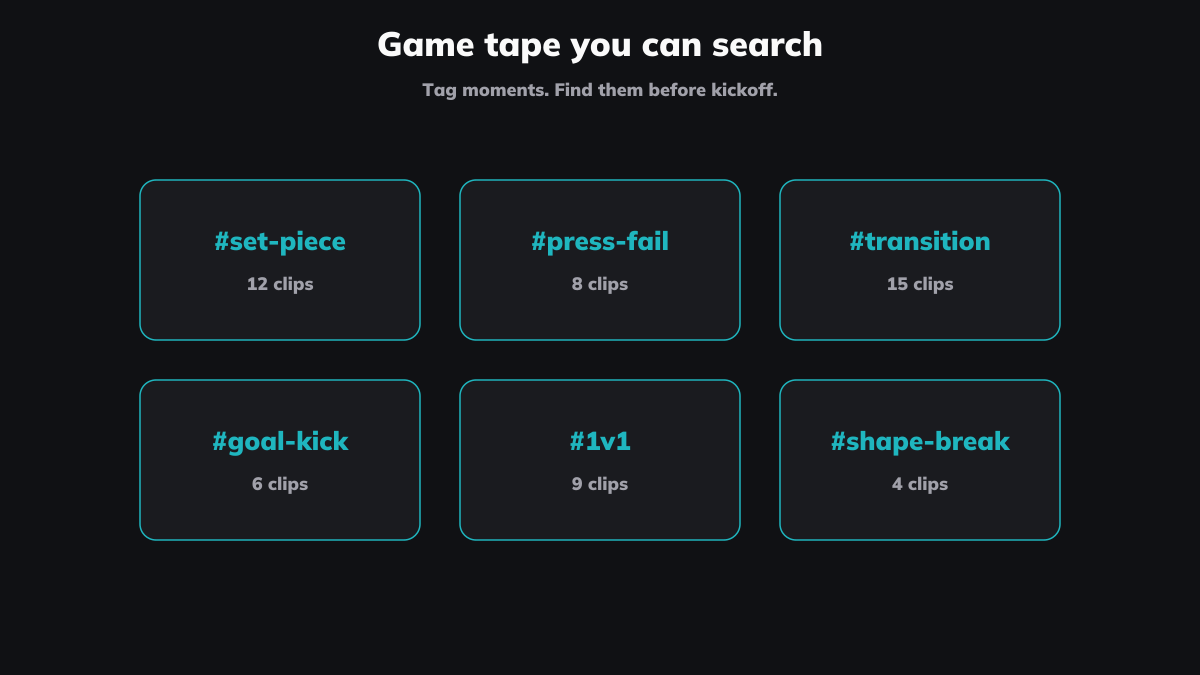
Tag every clip the way you actually think about the game:
- By player — so you can pull everything one athlete did, across six matches, in one search.
- By tactic or phase — set pieces, transition defence, build-up, the high press, second balls.
- By situation — 1v1 in the box, restart after conceding, last ten minutes with a lead.
- By drill — link a match moment to the session that fixes it.
The player tag is the one that changes your week. Friday before a meeting, search a name and watch every clip of that player back to back. The pattern they can't see in real time is obvious on tape — they're ball-watching at the back post, they're rushing the serve toss under pressure, they drop their elbow on the backhand. That's deliberate-practice feedback in its purest form: specific, visual, and about this attempt, not a general note.
Search transition defence + conceded and there's your recurring leak, on tape, across the whole season. Filter set piece + goal and you've got a highlight set of what's working — for confidence as much as instruction.
Sharing it with the team
A clip library you can search is a coaching tool. A clip set you can send is a team tool.
Pull together the eight clips for Tuesday's session — this week's defensive lesson, two examples of the press done right, the opposition's main threat — and share them as one Klipptik. The players open a link and watch the exact moments, in order, on their phones. No 90-minute file, no "skip to 34 minutes," no excuse.
Individual feedback works the same way. Send a player their own clips before training: here are your three best decisions last game, here are two to look at. Athletes who'd never sit through a full rewatch will watch ninety focused seconds about themselves. That's the version of review that actually gets watched.
Self-coaching counts too
This isn't only for coaches with a squad. The fastest-growing group reviewing footage is athletes coaching themselves.
A club tennis player films their serve, clips ten attempts, tags them good toss and dropped elbow, and watches the two sets side by side. The fault that no one was standing there to point out becomes obvious in a side-by-side. A swimmer clips turns. A lifter clips the last rep of every heavy set, where form breaks first.
And because a clip is just a timestamp over a video, your own footage and the explanations live in one library. The YouTube breakdown that finally made the serve motion click sits right next to your own ten attempts, tagged the same way. The model and the mirror, in one place.
Where Klipptik fits
This is what Klipptik does. Load your footage — game tape and training clips straight off your device, no upload of the video itself — and clip the moments as you review. Mark a start and end, tag by player, phase, or drill, and your season turns into a searchable personal video library instead of a hard drive you dread opening.
Search a player's name, get every clip of them. Filter set piece + conceded, watch them in sequence with one click. Bundle eight clips into a Klipptik and send the link to the team. The raw videos stay on your machine; Klipptik holds the timestamps and tags — the map back into your footage. And because the same library takes online video too, the technique breakdowns you reference sit beside the footage they explain.
It's honest to say what this isn't. Klipptik won't auto-record your matches like a Veo camera or generate team stat sheets like Hudl. If you need whole-pitch capture and a club analytics suite, those tools earn their cost. Klipptik is the lighter layer most coaches actually live in: clip what you already have, tag it the way you think, find it when the meeting's in two hours.
The compound season
One reviewed game is a team talk. A season of tagged clips is a coaching resource you keep.
By the back half of the year you're not scrubbing files — you're searching a library of your own team. Every player has a reel. Every recurring mistake is tagged and watchable. Next season's pre-season planning starts from evidence, not memory. And when a new player joins, you can show them exactly what "our press" looks like in eleven real examples instead of a whiteboard.
The footage was always there. Twenty hours of it. The coaches who get an edge from video aren't the ones who film the most — they're the ones who can find the four clips that matter, two hours before kickoff.
Build your coaching library — it's free to start.